January 20, 2025
GREAT FIGURES WHO HAD FAITH IN NICHIREN SHU GREAT FIGURES WHO HAD FAITH IN NICHIREN SHU (6)
JIUNDO HOSPITAL BUILT BY REV. NISSO TANABE
By Rev. Sensho Komukai
Rev. Nisso Tanabe was born in Chiba Prefecture in 1862. Ever since childhood, he was weak and sickly. Even so, he was assigned as the chief priest of Chokyuji Temple in Tokyo. At the age of 35, he was diagnosed with stomach cancer. The doctor recommended a gastric resection, but he was reluctant to have the operation. He said to himself, “As a Nichiren Shu priest, I have vowed to devote myself to the Dharma. Chapter 16 of the Lotus Sutra says, ‘This sutra is good medicine for the diseases of the people.’ Chapter 23 also says, ‘The patient who hears this sutra will be cured of his disease at once.’ When the end of my days come, I will accept it as the span of my life. Let me put my heart and soul into the Wonderful Dharma.”
From that time on, he concentrated on reading and chanting the Lotus Sutra all day while also doing daily suigyo (water-purification) practice. He also decided to undertake the 100-day aragyo ascetic practice at Nakayama Hokekyoji Temple. Those who are confined in aragyo training have to undergo suigyo practice seven times a day, chant the Lotus Sutra continually, copy a book of secrets by hand, and train for shuhou (a special blessing ritual). He would not even have regretted dying during the 100-day practice. Finally, he completed aragyo. Miraculously, the progress of his cancer had stopped.
Rev. Tanabe vowed to save as many suffering people as he could through special kito prayers. He mainly helped cure psychological problems, and many who had mental illnesses completely recovered through his kito prayers. Word of his great performance spread so widely by word of mouth that his temple was always full, with 30-40 sick people staying overnight to receive his kito prayers.
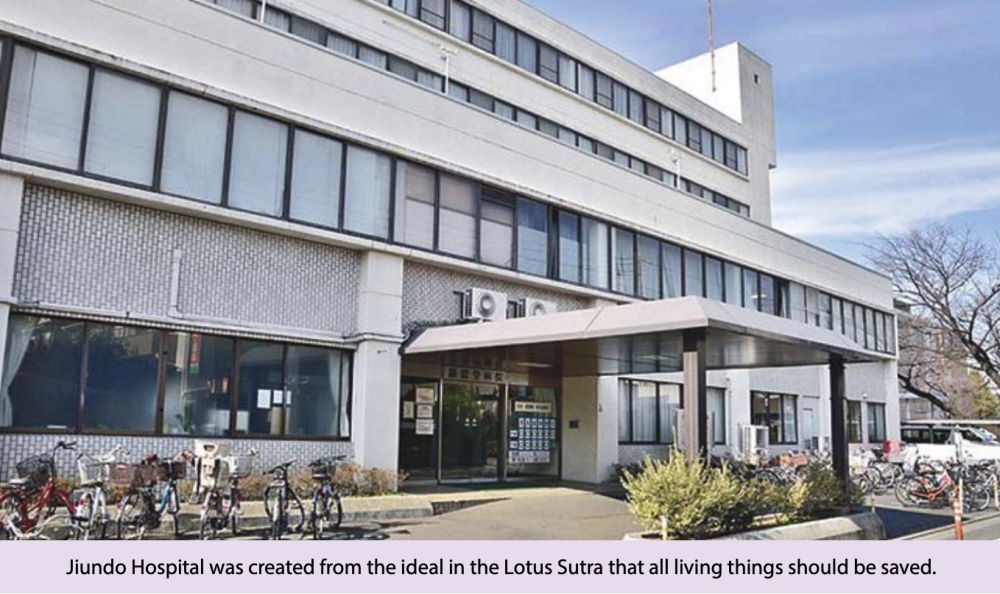
In 1927, Japanese laws were changed, requiring mentally disturbed people to be treated in hospitals. The families of the sick were at a total loss as to what to do, because those with mental illness had remained calm as long as they stayed at his temple. They implored Rev. Tanabe to help them. Rev. Tanabe thought that, if he gave up on them, it would go against the ideal of the Lotus Sutra that all living beings should be saved. He decided to build a medical institution. In 1929, a hospital called Jiundo Hospital was established in Tokyo’s Nerima Ward.
The hospital was able to accommodate 40 patients and had a worship hall that was 82 square meters (50 tatami mats) in size, where a mandala of the ten realms and a statue of the guardian deity Kishimojin (Hariti) were installed as the altar for invocation. At 6:00 each morning, Rev. Tanabe, the doctors, nurses, employees, and patients would gather in the worship hall and would hold an hour-long chanting service, which was followed by a special kito prayer conducted by Rev. Tanabe. In the hospital, the patients always carried their juzu beads and chanting books. The doctors and nurses tended to the patients as if they were providing care to the Buddha and deities.
Rev. Tanabe passed away at the age of 76. Today, Jiundo Hospital specializes in psychiatric care and internal medicine. The hospital still operates in the same place where it was established on the basis of Rev. Nisso Tanabe’s firm belief that all living beings should be saved with deep compassion.