January 20, 2025
GREAT FIGURES WHO HAD FAITH IN NICHIREN SHU GREAT FIGURES WHO HAD FAITH IN NICHIREN SHU (4)
By Rev. Sensho Komukai
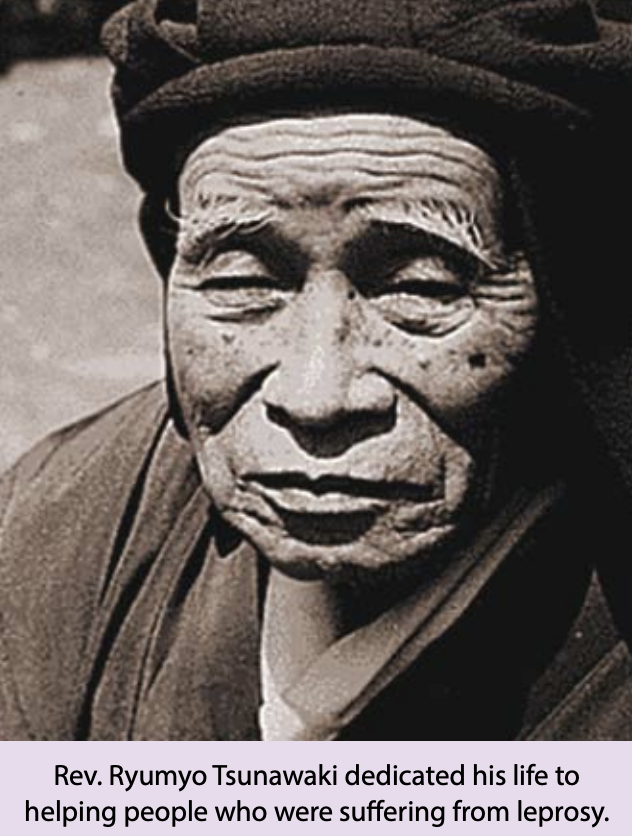
Ryumyo Tsunawaki (1876-1970) was born in Fukuoka in the Kyushu Region. He contracted tuberculosis at the age of 15. While recuperating, his religious faith in Buddhism awakened. He was deeply impressed with Never-Despising Bodhisattva, who always bowed to whomever he met. When Tsunawaki was 16, he received his ordination as a Nichiren Shu priest. He thought, “All human beings can become Buddhas. I have to bow with palms together to their precious lives.” To vow to be like Never-Despising Bodhisattva in front of Nichiren Shonin, he visited Mt. Minobu for the first time in July 1906.
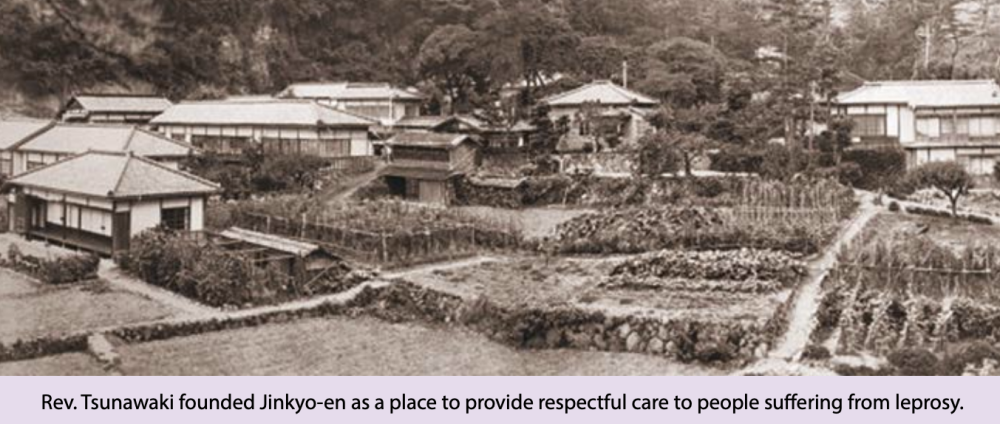
Paying a visit to the Founder’s tomb and passing through a temple gate, he found miserable huts standing alongside the river. He met a boy, about 15 or 16 years old, dressed like a beggar. The boy told him that he was suffering from leprosy. Rev. Tsunawaki was very shocked to see about 50 more people suffering from Hansen’s disease, from children to adults, living in such shabby old huts on Mt. Minobu with no way to recovery.
In those days, people thought that Hansen’s disease was incurable. A leprosy patient was improperly kept in isolation for fear of its infection spreading to others. Because the disease was thought to be hereditary, the patients, as well as their families, were treated badly and faced discrimination
Rev. Tsunawaki made up his mind to relieve the sufferers from Hansen’s disease, saying to himself, “These patients were abandoned by their parents and families. I vowed to practice the way of Never-Despising Bodhisattva. Isn’t it the Buddhist way of compassion to help those who are suffering from disease? I know it is not an easy task, but whatever difficulties may occur, I will achieve my goal to relieve them.”
In October 1906, he built a temporary sickroom in which 13 patients who had been laying along a riverbed were taken in. The hospital was named Jinkyo-en. Jin means “deep,” kyo is “respect,” and en literally means “garden.” The name of the hospital was taken from Chapter 20, “Never-Despising Bodhisattva” of the Lotus Sutra, in which the eponymous bodhisattva says, “I respect you deeply.
Later, it turned out that Hansen’s disease was completely curable. Still, there were no government policies on welfare, and few understood that the disease was curable. Rev. Tsunawaki had difficulty in raising funds, because of people’s prejudices. Even so, he never gave up. He established a good hospitalization facility that would become an incorporated foundation in 1920.
Rev. Tsunawaki cared for the patients with affection and without discrimination. He often said, “Everybody has a precious personality. We have only to accept each other’s existence. Your value as a Buddhist depends on whether you can respect everybody deeply. It is completely out of the question that you bow to them from a mere sense of obligation.” Since its opening, 1,436 patients suffering from Hansen’s disease were hospitalized and received medical care in Jinkyo-en until it closed in 1992.
As a Buddhist priest, Rev. Tsunawaki could not help but do something for the people suffering from leprosy. His motivation may have come from the great compassionate conviction that patients should not be abandoned even if they are incurable.