January 20, 2025
BuddhismQ&A
Why Do We Chant the Hoben-pon and Jiga-ge?
In Hokke Daimoku-sho, Nichiren Shonin called reciting the entire sutra the “expanded practice,” reciting Chapters 2 and 16 the “abbreviated” practice, and chanting the Odaimoku the “essential practice.” In Gassui Gosho, he particularly recommended reciting Chapters 2 and 16 of the Lotus Sutra because, while every chapter is meritorious, the other chapters are the branches and leaves of those two. It is evident that, while the Odaimoku is our essential practice, reciting Chapters 2 and 16 was also emphasized by Nichiren Shonin. Let’s look at what makes these two chapters particularly significant.
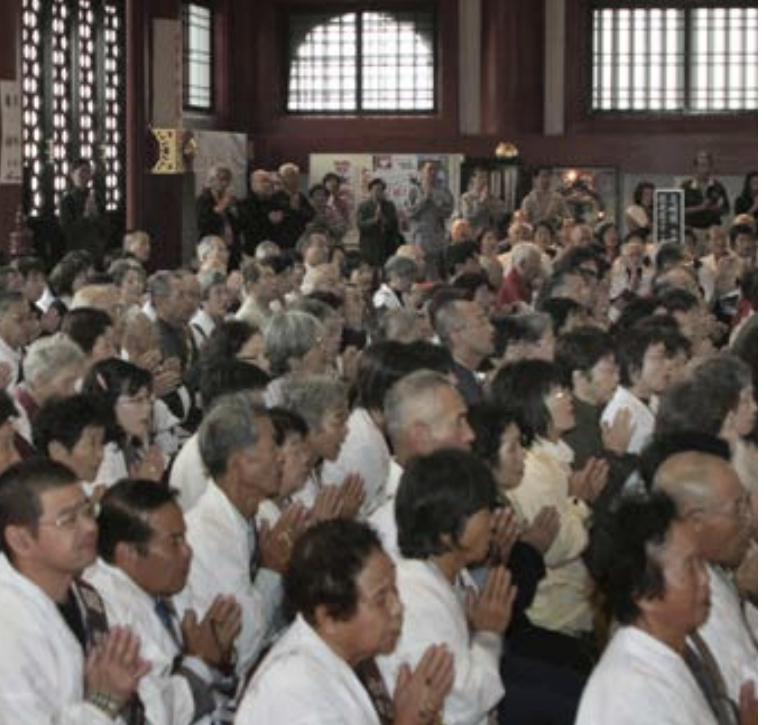
The passage from Chapter 2, “Skillful Means” (Hoben-pon), that is recited starts from the beginning of the chapter and ends with three repetitions of the so-called “ten suchnesses.” In this part of the sutra, Shakyamuni Buddha begins to speak. This passage is the “brief opening of the three vehicles to reveal the One Vehicle,” wherein he tells Shariputra that the wisdom of the Buddha goes beyond anything his disciples have heard or understood. This is a preamble to the rest of Chapter 2, wherein the Buddha reveals that all his teachings are the One Vehicle leading to buddhahood. All who follow the three vehicles, or teachings, will be able to attain buddhahood.
The verse half of Chapter 16, “The Duration of the Life of the Tathagata” is called the “Jiga-ge” in Japanese. It is a verse summary of the first half of the chapter. In it, the Buddha speaks of how he attained buddhahood in the remotest (taken to mean “timeless” or “eternal”) past and remains imperceptibly present, helping people attain Buddhahood. This means that the true nature of the Buddha’s awakened life is ungraspable, unconditioned, timeless, placeless, and active in all times and places. The true nature of Shakyamuni Buddha’s awakened life is also our own true nature. This buddha-nature speaks to us. It is our capacity for buddhahood, and it is everything about our life that draws us to buddhahood. As the Nirvana Sutra describes, it is only the unconditioned buddha-nature that is pure, blissful, eternal, and our true selfless self. In the Jiga-ge, the Eternal Shakyamuni Buddha is the voice of the true nature of all phenomena.
Chapters 2 and 16 are also integral for understanding the teaching of the three thousand realms in a single-thought moment (ichinen-sanzen), a key doctrine of Tiantai Buddhism that Nichiren Shonin highlighted in his own teachings. However, Nichiren Shonin taught that the true meaning of this doctrine was hidden in the depth of Chapter 16, and its actualization occurred in the chanting of the Odaimoku.
We welcome readers’ questions about Buddhism and Nichiren Shonin. Please send us your questions by e-mail to editor-nichirenshunews@nichiren.or.jp or contact us through your local temple.