January 20, 2025
BuddhismQ&A
Why do we chant the last part of Hoben-pon three times?
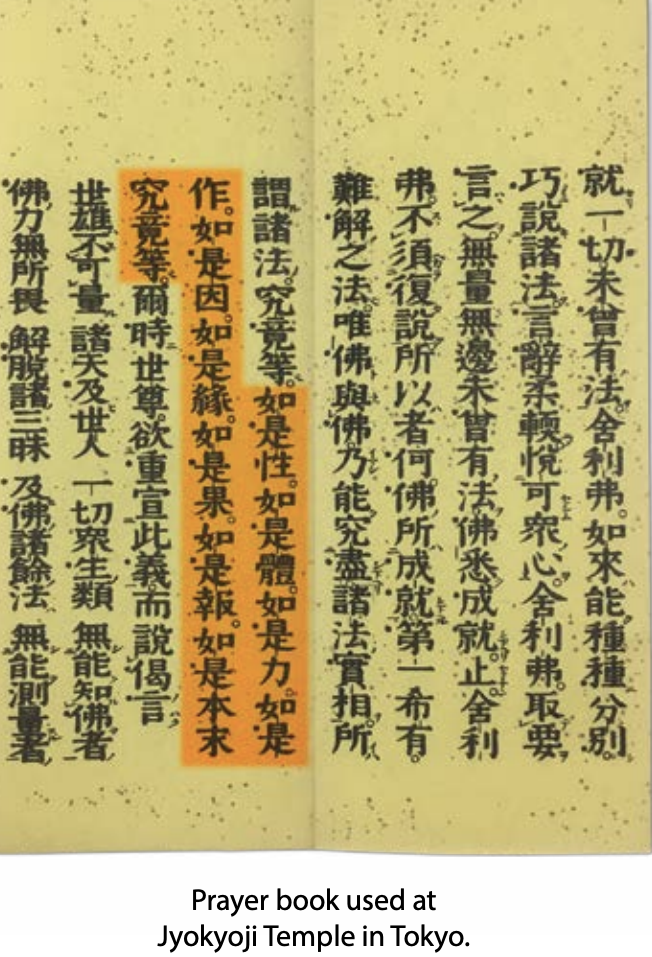
A common practice of Nichiren Buddhism is a triple repetition of a portion of the opening prose section of Chapter 2 of the Lotus Sutra, but not many know why we do this. In English, this passage reads: “…that is all phenomena in regard to their appearances as such, their natures as such, their entities as such, their powers as such, their activities as such, their causes as such, their conditions as such, their effects as such, their recompenses as such, and their equality as such despite these differences.” This is the list of the “ten suchnesses” or aspects of phenomena (dharmas in Sanskrit) that comprise reality.
The three repetitions are actually a recognition of three ways of reading the ten suchnesses in accordance with threefold truth taught by Tiantai Zhiyi (538-597). The threefold truth consists of: (1) the truth of emptiness, meaning that all phenomena are empty of a permanent, unchanging or independent self-nature; (2) the truth of provisionality, meaning that nevertheless they do have a provisional existence on the basis of the interdependent flow of causes and conditions; and (3) the truth of the middle way, meaning that things are simultaneously empty and provisionally existent. All three truths of the threefold truth imply one another. Because things have no self-nature, they have a provisional existence, and vice versa. Both emptiness and provisionality express the middle way of empty yet provisionally existent. This is a very subtle and complex teaching which is at the heart of Tiantai Buddhism and was also held in great esteem by Nichiren Shonin.
In the Profound Meaning of the Lotus Sutra, the Great Master Tiantai points out that by rearranging the Chinese characters of each of the ten phrases, one can read them so that one part or another of the threefold truth is emphasized. The first way is to emphasize the suchness of each of the ten. Because suchness is a synonym for emptiness this is a recognition of the truth of emptiness. For instance, to read “such their appearance is” (ze-so-nyo; 是相如). The second way is to emphasize the distinct character of each of the ten as a recognition of the truth of provisionality. For instance, to read, “their appearances as such” (nyo-ze-so; 如是相). The third way is to emphasize the copula “as,” representing the truth of the middle way. For instance, to read “as such their appearance” (so-nyo-ze; 相如是).
This doesn’t work as well in English as in classical Chinese, and we don’t actually rearrange the characters in our own practice. Nevertheless, the triple repetition is a way of recognizing that each of the ten suchnesses should be understood in terms of the threefold truth of emptiness, provisionality, and the middle way.
We welcome readers’ questions about Buddhism and Nichiren Shonin. Please send us your questions by e-mail to editor-nichirenshunews@nichiren.or.jp or contact us through your local temple.